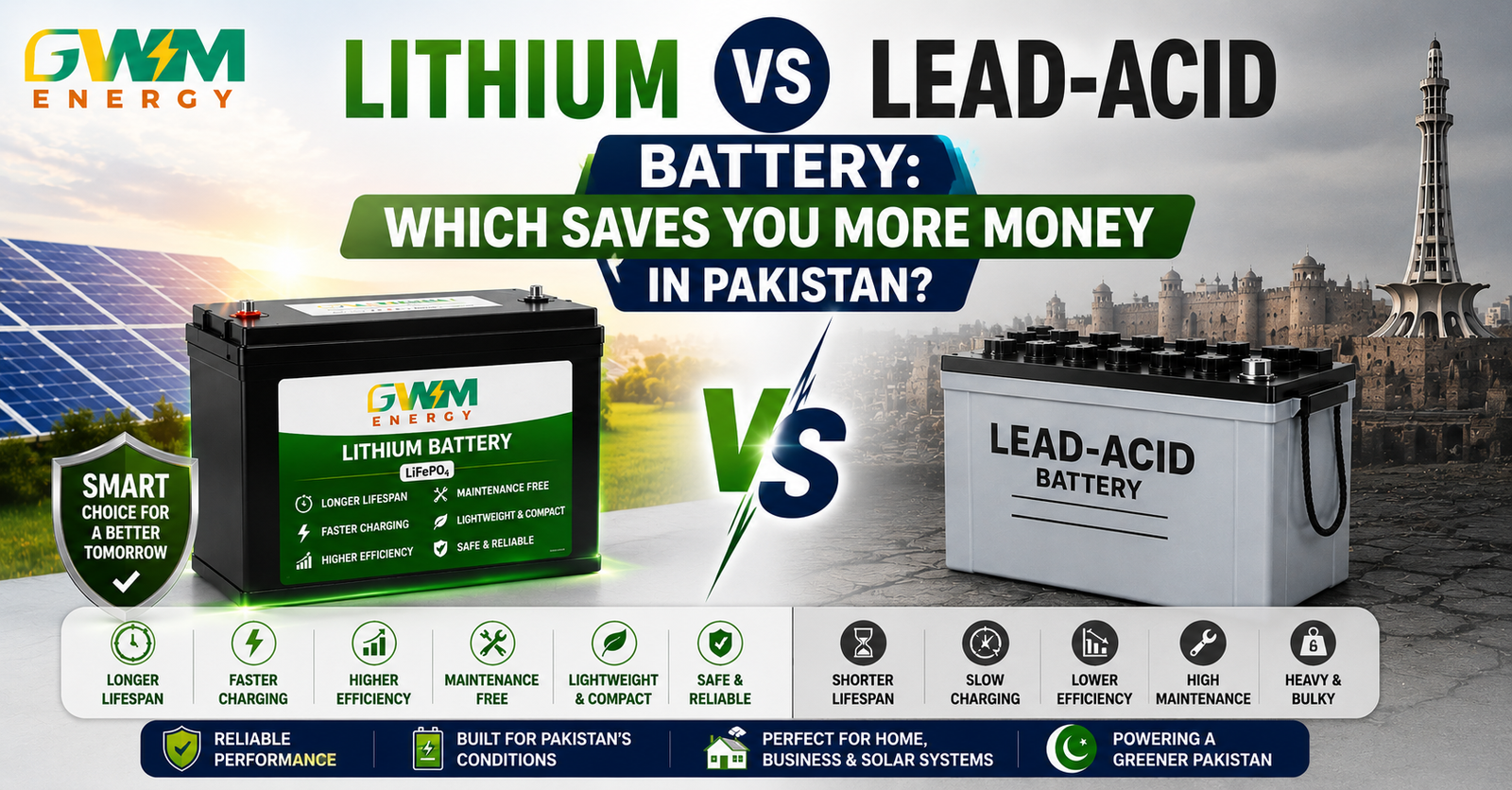
If you are planning a solar or backup power system in Pakistan, one question almost always comes up:
Should you save money today with a lead-acid battery, or invest more upfront in lithium?
At first glance, lead-acid seems like the cheaper option. Walk into almost any battery market and you will usually find lead-acid batteries available at a noticeably lower price than LiFePO4 lithium batteries.
But the price you pay on day one does not tell the full story.
Battery replacement, maintenance, usable capacity, charging efficiency, load-shedding frequency, and daily solar usage can significantly change the real cost of ownership.
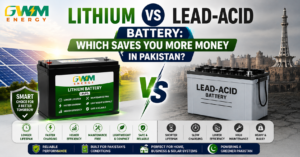
So, which battery actually saves you more money in Pakistan?
Let’s compare them properly.
Why Lead-Acid Batteries Look Cheaper
Lead-acid batteries remain popular across Pakistan for one simple reason: their initial purchase price is lower.
They are widely available, familiar to technicians, and suitable for basic backup requirements. If you only need to power a few lights, fans, or essential appliances during occasional outages, a lead-acid battery may appear to be the sensible budget option.
The problem begins when that battery becomes part of your everyday energy system.
Frequent load-shedding, daily solar charging, and repeated discharge cycles put significant stress on lead-acid batteries.
Over time, capacity begins to decline, backup duration becomes shorter, and battery replacement becomes necessary.
That is where the real cost difference starts to appear.
Lithium Costs More Upfront — But Gives You More Usable Energy
One of the most important differences between lithium and lead-acid batteries is how much of the rated battery capacity you can comfortably use.
A lead-acid battery should generally not be deeply discharged on a regular basis because repeated deep discharge can significantly shorten its service life.
LiFePO4 batteries, on the other hand, are designed to handle deeper discharge levels and regular cycling much more effectively.
That means more of the energy stored inside the battery is available for actual use.
Instead of comparing batteries only by:
Price + Voltage + Ah
A better comparison is:
Price + Usable Energy + Expected Lifetime
That tells you much more about the battery’s true value.
Replacement Cost Is Where Lithium Starts to Make Sense
This is where many buyers change their minds.
A lead-acid battery may cost less when you first buy it, but if it needs replacing multiple times during the life of your solar system, the total cost increases quickly.
Lithium batteries typically offer a much longer cycle life when operated under the correct conditions.
Think about the difference like this:
Lead-Acid:
Buy → Use → Capacity Drops → Replace → Repeat
Lithium:
Higher Initial Cost → Longer Service Life → Fewer Replacements
For households and businesses that use battery backup every day, fewer replacements can make a major financial difference over several years.
The cheapest battery today is not always the cheapest battery to own.
Pakistan’s Climate Makes Battery Quality Even More Important
Battery performance in Pakistan is affected by more than just load-shedding.
High summer temperatures can also influence battery life, particularly when batteries are installed in poorly ventilated areas or operate under heavy loads.
Heat, improper charging, and repeated deep discharge can accelerate battery degradation.
LiFePO4 chemistry is widely preferred for modern energy storage applications because of its thermal stability, long cycle life, and suitability for repeated charging and discharging.
However, even a lithium battery should always be installed within the temperature and operating limits recommended by the manufacturer.
In Pakistan’s climate, good battery technology and correct installation go hand in hand.
Maintenance Also Costs Money
Lead-acid batteries can require regular attention depending on the type of battery being used.
Maintenance may involve:
- Checking electrolyte levels
- Adding distilled water
- Cleaning battery terminals
- Monitoring corrosion
- Ensuring ventilation
- Checking charging performance
- Replacing weak batteries in a battery bank
These tasks may not seem expensive individually, but over several years they add time, inconvenience, and sometimes additional service costs.
LiFePO4 batteries are generally much easier to maintain.
A modern lithium battery typically includes a Battery Management System, commonly known as a BMS, which helps manage and protect the battery during charging and discharging.
For users who want a more convenient and low-maintenance energy storage solution, lithium offers a clear advantage.
Charging Efficiency Can Save Energy Over Time
Every time a battery is charged and discharged, some energy is lost.
The amount of energy lost depends on battery chemistry, system design, inverter configuration, and operating conditions.
LiFePO4 batteries generally offer higher charging and discharging efficiency compared with traditional lead-acid batteries.
For a solar user, this means more of the energy generated by solar panels can be stored and later used by appliances.
The difference may appear small during one charging cycle.
But over hundreds or thousands of cycles, better efficiency can contribute to greater overall system value.
Faster Charging Is Valuable During Load-Shedding
Pakistan’s electricity situation can be unpredictable.
Sometimes the grid returns only briefly before another power interruption occurs.
In situations like this, faster battery charging becomes extremely valuable.
LiFePO4 batteries can generally accept higher charging rates when used with a compatible inverter and correct charging configuration.
This makes them particularly useful for:
- Homes with solar systems
- Offices
- Shops
- Schools
- Clinics
- Hotels
- Restaurants
- Commercial buildings
- Industrial facilities
If your battery can recover more quickly between outages, you have a better chance of maintaining reliable backup.
A Simple Long-Term Cost Comparison
Exact battery prices can change depending on brand, capacity, cell quality, exchange rates, and market conditions.
So instead of focusing on a fixed market price, consider the total ownership cost.
Lead-Acid Battery Cost
You may need to calculate:
Initial Purchase + Replacement Batteries + Maintenance + Installation Labour + Reduced Usable Capacity + Energy Losses
Lithium Battery Cost
You may have:
Higher Initial Purchase + Longer Service Life + Higher Usable Capacity + Lower Maintenance + Fewer Replacements
If you compare only the first invoice, lead-acid usually wins.
If you compare several years of regular battery use, lithium can become the more economical option.
When Does Lead-Acid Still Make Sense?
Lead-acid is not automatically the wrong choice.
It may still be suitable when your backup requirements are limited and your budget is very tight.
Lead-acid can make sense for:
- Occasional UPS backup
- Basic emergency lighting
- Small shops
- Limited appliance loads
- Short backup periods
- Temporary installations
If the battery is rarely discharged, investing significantly more in lithium may not always be necessary.
When Does Lithium Make More Financial Sense?
Lithium becomes much more attractive when battery usage is frequent.
It is particularly suitable for homes and businesses that charge and discharge their batteries almost every day.
Lithium may offer better value if you need:
- Daily solar energy storage
- Longer battery lifespan
- Faster charging
- Higher usable capacity
- Lower maintenance
- Reliable backup
- Fewer battery replacements
- Future system expansion
- Commercial or industrial energy storage
The more frequently you use your battery, the more important efficiency, cycle life, and usable capacity become.
Lithium vs Lead-Acid: Quick Comparison
| Feature | LiFePO4 Lithium Battery | Lead-Acid Battery |
| Initial Cost | Higher | Lower |
| Long-Term Value | Stronger for frequent use | Better for occasional use |
| Cycle Life | Higher | Lower |
| Usable Capacity | Higher | Lower |
| Maintenance | Minimal | May require regular maintenance |
| Charging Speed | Faster | Slower |
| Weight | Lighter for comparable usable energy | Heavier |
| Daily Solar Use | Highly suitable | Less suitable for deep daily cycling |
| Replacement Frequency | Lower | Higher |
| Scalability | Better | Limited |
| Best For | Homes, solar, ESS & BESS | Basic or occasional backup |
Which Battery Saves You More Money?
The answer depends on how you plan to use your battery.
If your priority is the lowest purchase price today:
Lead-acid usually costs less.
If your priority is long-term performance and regular daily use:
LiFePO4 lithium can deliver better overall value.
This is why buyers should avoid asking only:
“Which battery is cheaper?”
The better question is:
“Which battery will give me more usable backup energy for every rupee I spend over its lifetime?”
That is the comparison that really matters.
Do Not Ignore the BMS When Buying Lithium
Not every lithium battery offers the same quality.
A reliable Battery Management System is one of the most important parts of a modern lithium battery.
A good BMS helps protect against:
- Overcharging
- Over-discharge
- Excessive current
- Short circuits
- Abnormal temperatures
- Cell imbalance
This is why buyers should look beyond voltage, Ah rating, and price.
Cell quality, BMS design, warranty, inverter compatibility, and local technical support can all influence how well the battery performs over time.
A cheap lithium battery with poor cells or an unreliable BMS may not deliver the benefits you expect from LiFePO4 technology.
What About 5kW to 10kW Solar Systems?
Many Pakistani homes now use 5kW, 6kW, 8kW, or 10kW hybrid solar systems.
For these installations, 48V or 51.2V LiFePO4 battery systems are commonly used.
However, inverter size alone does not determine the correct battery capacity.
Your battery should be selected according to:
- Total appliance load
- Number of backup hours required
- Solar generation
- Peak power demand
- Available charging current
- Future expansion requirements
A household running only lights, fans, and a refrigerator needs a very different battery system from a home running air conditioners, pumps, freezers, and multiple heavy appliances.
A proper load calculation can help prevent both overbuying and underbuying.
Frequently Asked Questions
Is lithium cheaper than lead-acid in Pakistan?
Lithium normally costs more upfront.
However, for frequent solar usage and regular cycling, its longer lifespan, higher usable capacity, lower maintenance, and fewer replacements can make it more economical over the long term.
Which battery is better for daily load-shedding?
For frequent load-shedding, LiFePO4 lithium is generally the stronger choice because it is designed for regular cycling, faster charging, and deeper usable capacity.
Lead-acid may still work well for occasional backup.
Does a lithium battery require maintenance?
LiFePO4 batteries normally require very little routine maintenance compared with flooded lead-acid batteries.
However, correct installation, inverter settings, ventilation, cable sizing, and operating temperature are still important.
Can I replace lead-acid batteries with lithium?
In many cases, yes.
However, your inverter or charger must support the correct lithium battery voltage and charging parameters.
Some systems may also require communication between the inverter and battery BMS.
Compatibility should always be checked before installation.
Which battery is best for solar panels?
For solar systems that charge and discharge batteries regularly, LiFePO4 is generally a stronger long-term choice.
Lead-acid may still be suitable for lighter or occasional backup requirements.
Are all lithium batteries the same?
No.
Lithium batteries can differ significantly in:
- Cell quality
- Battery Management System
- Warranty
- Enclosure design
- Safety features
- Cycle life
- Inverter compatibility
- Local service support
Two batteries showing the same voltage and Ah rating may offer very different performance over their lifetime.
Conclusion: Think Beyond the Purchase Price
Choosing between lithium and lead-acid is not simply a question of which battery costs less today.
Lead-acid remains a practical option for buyers with limited budgets and occasional backup requirements.
But for homes, offices, businesses, and industrial facilities where batteries are charged and discharged frequently, LiFePO4 lithium can offer significantly stronger long-term value.
Longer service life, higher usable capacity, faster charging, reduced maintenance, and fewer replacements can make the higher upfront investment worthwhile.
The smartest buying decision is therefore not based on the cheapest battery on the shelf.
It is based on total cost of ownership, reliability, safety, and how much usable energy the battery delivers throughout its lifetime.
Ready to Choose the Right Battery for Your Solar System?
Do not guess your battery capacity or choose a system based only on price.
Your daily load, required backup time, inverter capacity, charging source, and future expansion plans should all be considered before making a decision.
GWM Energy provides advanced LiFePO4 lithium batteries, Home Energy Storage Systems, Commercial ESS, and Industrial BESS solutions designed for reliable and efficient energy storage.
Whether you are upgrading from lead-acid, installing a new solar backup system, or planning a commercial or industrial energy storage project, the right battery can help you reduce long-term costs and improve energy reliability.
Talk to a GWM Energy Expert Today
Get professional guidance on:
- Choosing the right lithium battery capacity
- Matching your battery with your inverter
- Home solar backup solutions
- Commercial energy storage
- Industrial BESS systems
- Future system expansion
Explore GWM Energy’s lithium battery and energy storage solutions today and build a smarter, more reliable power system for tomorrow.