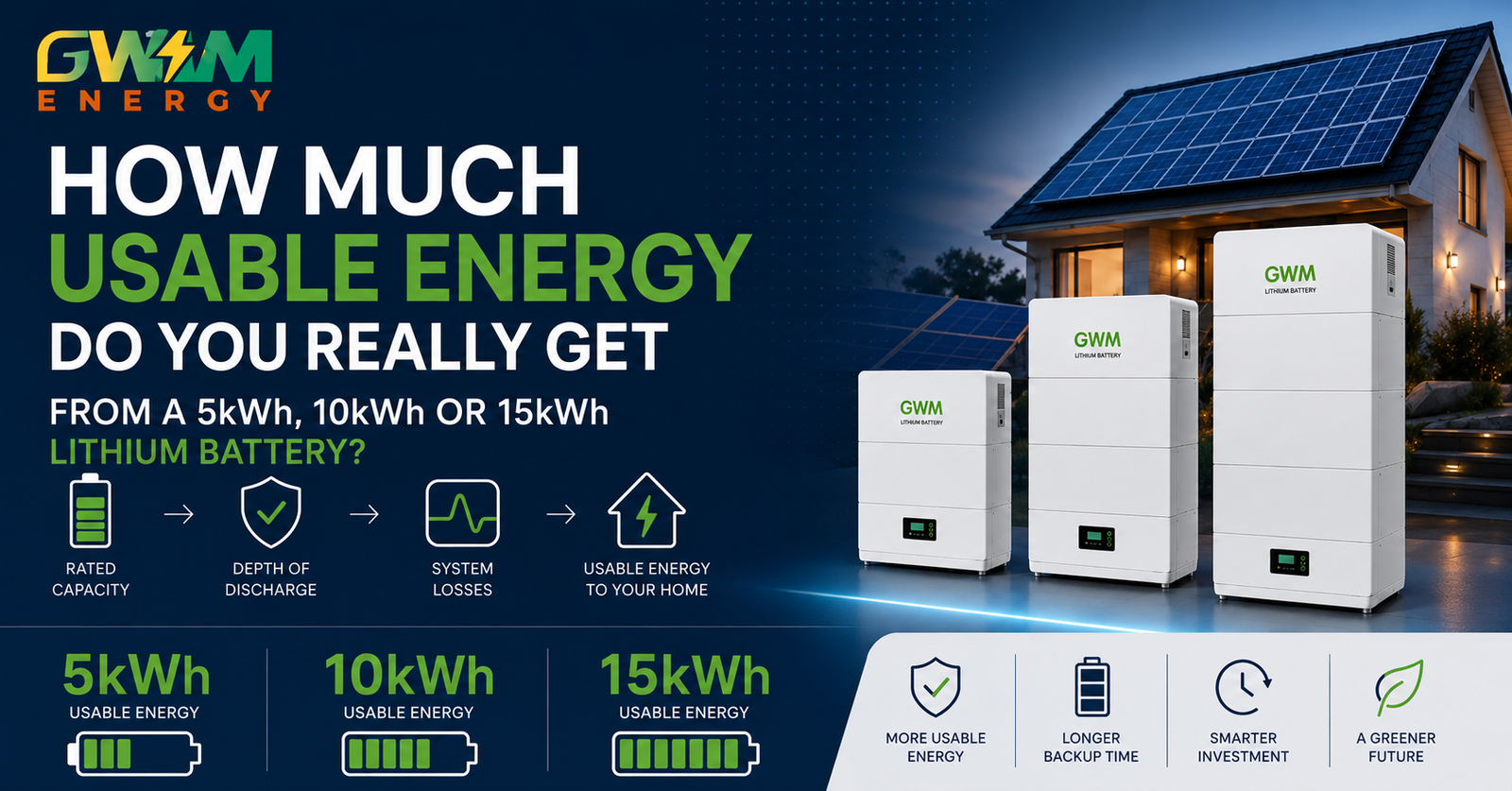
Anyone who has looked at lithium batteries for a home or solar system has probably seen the same numbers again and again:
5kWh.
10kWh.
15kWh.
At first, it looks simple. Bigger number means more backup.
But there is one thing most buyers are never properly told:
The capacity written on the battery is not always the exact amount of energy you will actually use inside your home.
While a small portion of battery capacity is reserved for protection and some energy is naturally lost through the inverter, choosing the right storage solution from GWM Energy can help you achieve reliable backup and better solar energy use in Pakistan.
Usable energy matters more than the number printed on the box.
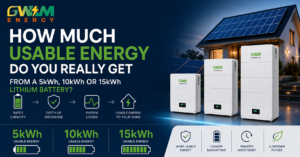
This guide explains how much practical energy you can expect from 5kWh, 10kWh and 15kWh lithium batteries, what affects backup time, and how to choose the right size for your home or business.
What Does Usable Energy Actually Mean?
Let’s keep this simple.
If a lithium battery is rated at 10kWh, that is its total rated storage capacity.
But the battery usually does not allow you to drain every last bit of that energy.
Why?
Because lithium batteries use a Battery Management System, or BMS, to protect the battery from things like:
- Overcharging
- Deep discharge
- High temperature
- Excess current
- Short circuits
This protection helps the battery perform safely and supports a longer service life.
So when comparing batteries, do not only look at the total capacity.
Look at how much energy is actually available for your home.
So How Much Energy Does a 5kWh Lithium Battery Really Give?
A 5kWh-class lithium battery is one of the most practical options for small and medium homes in Pakistan.
A battery around this size can comfortably support normal household essentials such as:
- Fans
- Lights
- Refrigerator
- TV
- Wi-Fi router
- Laptop
- CCTV system
- Small electronics
For a family mainly looking for backup during load-shedding, this can be enough.
But there is a big difference between running five fans and lights versus running an AC at the same time.
The heavier your load, the faster the battery will discharge.
A Simple Example
Suppose your home is running:
- 4 fans
- 6 LED lights
- 1 refrigerator
- 1 TV
- Wi-Fi router
- 1 laptop
This is a relatively light household load.
A 5kWh battery can provide several hours of backup in this situation.
Now switch on an air conditioner.
Your electricity use immediately increases, which means the same battery will give much less backup time.
The battery has not changed.
Your load has.
That is why there is no single answer to:
How many hours does a 5kWh battery last?
without first knowing what you are running.
What About a 10kWh Lithium Battery?
A 10kWh battery gives you much more room to work with.
It is better suited to homes where electricity usage is higher or where longer backup is required.
It can support things like:
- Multiple fans
- Lights
- Refrigerators
- TV
- Computers
- Internet equipment
- Selected kitchen appliances
- Inverter air conditioner
- Other essential home loads
For many medium and large homes, this size gives a good balance between backup time and investment.
It is especially useful if you want to store solar energy during the day and use that stored energy in the evening or at night.
And What About a 15kWh Lithium Battery?
A 15kWh-class battery is for people who need significantly more storage.
This may include:
- Large homes
- Multiple inverter ACs
- Offices
- Shops
- Small businesses
- Higher nighttime energy use
- Longer backup requirements
A larger battery can also make sense if your solar system produces plenty of electricity during the day but you want to use more of that energy after sunset.
That is where battery storage becomes more than just a load-shedding solution.
It becomes part of how you manage your electricity every day.
5kWh vs 10kWh vs 15kWh: What Is the Real Difference?
Here is the easiest way to think about it:
| Battery Size | Best For | Typical Use |
|---|---|---|
| 5kWh | Small to medium homes | Essential home backup |
| 10kWh | Medium to large homes | Longer backup + selected heavy loads |
| 15kWh | Large homes / small businesses | Higher loads + extended storage |
But battery capacity alone does not tell the full story.
Two homes using the same 10kWh battery may get completely different backup times.
One household might run fans, lights and a refrigerator.
Another might run:
- 2 ACs
- Water pump
- Refrigerator
- Deep freezer
- Multiple TVs
- Computers
Same battery.
Completely different backup.
Why Does Actual Backup Time Change So Much?
There are several reasons.
Your Appliance Load
This is the biggest factor.
The more electricity your appliances use, the faster your battery empties.
Air Conditioner Usage
ACs are usually among the biggest household loads.
An inverter AC can become more efficient after the room cools down, but it still uses much more energy than basic lights or fans.
Inverter Efficiency
The battery stores DC energy.
Most household appliances use AC electricity.
Your inverter converts one into the other, and a small amount of energy is naturally lost during that process.
Battery Management System
The BMS protects the battery and controls charging and discharging.
It helps monitor important things like voltage, current and temperature.
Temperature
Pakistan gets hot.
Very hot.
Battery installation conditions matter, especially when equipment is placed in poorly ventilated areas.
Good installation helps the system operate properly.
Battery Quality
Not every battery with the same voltage and capacity is equal.
Cell quality, BMS quality, cycle life and manufacturing standards all affect long-term performance.
This is why two batteries that look similar on paper can perform very differently in real use.
Do Not Choose a Battery Based Only on Your Inverter Size
This is another common mistake.
A homeowner has a 5kW inverter and immediately assumes:
“I need a 5kWh battery.”
That is not necessarily true.
Your inverter size tells you how much power the system can handle.
Your battery size tells you how much energy you can store.
They are related, but they are not the same thing.
Instead, battery sizing should depend on:
- Your appliances
- Total electricity usage
- Required backup time
- Nighttime consumption
- Solar generation
- AC usage
- Future requirements
That is how you choose the right system.
What Size Battery Is Best for a Normal Pakistani Home?
There is no one-size-fits-all answer, but here is a practical starting point.
5kWh May Be Enough If:
You mainly want to run:
- Fans
- Lights
- Refrigerator
- TV
- Wi-Fi
- Basic electronics
and your backup requirement is moderate.
10kWh May Be Better If:
You want:
- Longer backup
- More appliances
- Some AC usage
- Higher nighttime energy storage
- More flexibility
15kWh May Be Better If:
You have:
- A large home
- Multiple high-power appliances
- Longer backup requirements
- Higher solar generation
- Office or small commercial loads
The correct choice should always be based on your actual consumption.
Bigger Battery Does Not Always Mean Better
This is worth saying clearly.
Buying the biggest battery available is not automatically the smartest decision.
If your home only uses a small amount of energy during the period you need backup, buying a 15kWh system may mean paying for capacity you rarely use.
On the other hand, buying too small a battery can leave you short during load-shedding or at night.
The goal is simple:
Buy enough storage for your real needs, with some room for future growth.
Expandable systems are useful because you can increase capacity later instead of replacing the entire setup.
What Should You Check Before Buying?
Before choosing between 5kWh, 10kWh and 15kWh, ask these questions:
- How many appliances do I need during backup?
- Do I want to run an AC?
- How many hours of backup do I want?
- How much solar energy do I produce?
- How much electricity do I use after sunset?
- Is my inverter compatible with lithium batteries?
- Can I expand the system later?
- What battery chemistry is being used?
- What BMS protection is included?
- What cycle life and warranty are offered?
These questions will tell you much more than simply asking for the cheapest price.
Frequently Asked Questions
Is a 5kWh lithium battery enough for a home?
For many small and medium homes, yes.
It can handle normal essential loads such as fans, lights, refrigerator, TV and electronics.
Heavy loads will reduce backup time.
Can a 5kWh battery run an AC?
Yes, depending on the battery, inverter, AC load and other appliances running at the same time.
However, AC usage will discharge the battery much faster than normal household loads.
Is 10kWh enough for a large home?
It can be, but it depends on your electricity consumption.
A home with one AC and basic appliances will have very different energy requirements from a house with multiple ACs, pumps and refrigerators.
Is a 15kWh battery good for solar?
Yes A larger battery can store more daytime solar generation for evening and nighttime use, provided the solar and inverter system is properly designed.
What is better: one large battery or multiple smaller batteries?
Both options can work.
Modular systems give you the advantage of easier expansion, while a properly sized single system can provide a simpler setup.
The right option depends on your installation and future plans.
How long do LiFePO₄ batteries last?
Battery life depends on the battery quality, number of cycles, operating temperature, depth of discharge and overall system conditions.
A good-quality LiFePO₄ battery can provide long-term performance when properly installed and used.
Conclusion
So, how much usable energy do you really get from a 5kWh, 10kWh or 15kWh lithium battery?
The answer depends on more than the number printed on the battery.
What really matters is:
- Battery capacity
- Usable discharge
- Your household load
- Inverter efficiency
- AC usage
- Battery quality
- System design
For basic home backup, a 5kWh battery may be enough.
For longer backup and higher loads, 10kWh can make more sense.
For large homes and small commercial setups, 15kWh gives you much more storage flexibility.
But the best battery is not the biggest one.
It is the one that matches the way you actually use electricity.
Ready to Choose the Right Battery System?
Choosing a lithium battery should not be guesswork.
GWM Energy provides LiFePO₄ battery and energy-storage solutions for residential, commercial and industrial applications.
Whether you need 5kWh for essential backup, 10kWh for longer home storage, or a larger system for higher energy demand, the right setup starts with understanding your actual load.
Talk to a GWM Energy expert and choose a battery system based on your real energy requirements, future plans and solar setup.
Related Reading
- Lithium Battery Price in Pakistan 2026: Complete Buyer’s Guide by Capacity
- Lithium vs Lead-Acid Battery: Which Saves You More Money in Pakistan?
- Home Energy Storage Solutions
- Commercial Energy Storage Systems
- Industrial BESS Solutions